Estaba tomando un café con mi mamá cuando en el lugar pusieron éste video y pensé "¡Diablos! ¿No es ese John Malkovich en vestuario del siglo XVIII?" Y sí que lo era. Ésta es una canción de 1992 de Annie Lennox y el video está claramente basado en el genial filme de 1988 Dangerous Liaisons, de hecho me parece que el lugar donde fue grabado el video es el mismo que era la casa del personaje de Glenn Close en la película. Como sea. En el video hay un poco de Hugh Laurie con todo y peluca y lunar en forma de corazón (extrañamente lindo), Annie Lennox con un tocado a la turca y todo lo demás en tonalidades crema. MUY a la dangerous liaisons.
I was at the coffee with my mom and they played this video and I though "damned! isn't that John Malkovich in 18th century costume??!!" And well, he was. This is a 1992 song by Annie Lennox and the video is clearly bassed in the gorgeous 1988 film Dangerous Liaisons, I even think the place the video was filmed was the house where the Glenn Close character lived in the film. Whatever. There is also some Hugh Laurie in this video with wig and heart shaped beauty spot (strangely cute), Annie Lennox with a turkish headpiece and lots of cream coloured costumes. VERY dangerous liaisons.
sábado, 11 de junio de 2011

miércoles, 25 de mayo de 2011
Golden Times
Ok, he vuelto. Al final creo que no haré una tesis de verdad para graduarme, pero como sea quiero seguir con la investigación sobre... bueno, cosas del siglo XVIII. Hoy debo confesar que había olvidado ésta colección y los maravillosos anuncios de Dolce&Gabbana inspirados en la era rococó y regencia.
Well, I'm back. At the end I think I'm not gonna make an actual thesis, but anyway I will continue with my investigation on.... well, 18th century stuff. This time I've got to confess I had forgotten this gorgeous collections and the marvelous ads from Dolce&Gabbana inspired by the rococo and regency eras.


Well, I'm back. At the end I think I'm not gonna make an actual thesis, but anyway I will continue with my investigation on.... well, 18th century stuff. This time I've got to confess I had forgotten this gorgeous collections and the marvelous ads from Dolce&Gabbana inspired by the rococo and regency eras.
Dolce&Gabbana Ad Campaign
Autum - Winter 2006
Photography Steven Meisel (who else?!)
Models Gemma Ward, Julia Stegner, Iselin Steiro, Snejana Onopka, Ines Crnokrak, Coco Rocha, Lily Donaldson, Morgane Dubled, Caitriona Balfe, Chad Dunn, Cosmin Petre, David Gandy, Terron Wood, and Sam Saffman


miércoles, 20 de octubre de 2010
miércoles, 13 de octubre de 2010
Detalle
Detalle de encaje y pasamanería en los holanes del puño de un vestido de novia.
Lace detail on cuff ruffles of a wedding dress.
Via Watzittoceska Flickr

Lace detail on cuff ruffles of a wedding dress.
Via Watzittoceska Flickr
jueves, 30 de septiembre de 2010
Cause me pain Hedi Slimane
"CAUSE ME PAIN HEDI SLIMANE"
Recuerdo perfecto esa camiseta de House of Holland... y recuerdo que yo la quería; de hecho aún la quiero. En aquellos tiempos Slimane aún era el diseñador de Dior Homme y yo AMABA su trabajo ahí. Aún lo amo. Hoy en día es... como... En realidad no se exactamente qué hace, pero una de esas cosas que hace es la fotografía. Y lo hace muy bien con su ahora característico blanco y negro. A veces entro a su blog y realmente me inspira. Y ésta entrada en su visual diary realmente me movió a mí y a mi obsesión de retratos-británicos-del-siglo-XVIII
"CAUSE ME PAIN HEDI SLIMANE"
I perfectly remember that House of Holland tee... and I remember I wanted it; as a matter of fact, I sill want it. In those times Slimane was still the Dior Homme head designer and I LOVED his work there.I still love it. Nowadays he is like... I do not really know exactly what does he do, but one of the things he does is photography. And he does it pretty well with his now signature balck and white. Sometimes I enter his blog and he really inspires me. And this entry in his visual diary really moved me and my 18th-century-british-portraits obsession.


All Photos by Hedy Slimane, 2010
Source / Fuente:
domingo, 26 de septiembre de 2010
shoes, shoes, SHOES! / ¡¡ZAPATOS!!
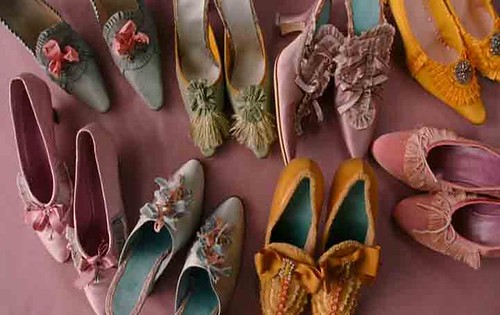
Shoes by Manolo Blahnik for the Sofia Coppola's film Marie Antoinette, 2006
Zapatos diseñados por Manolo Blahnik para el filme Marie Antoinette de Sofia Coppola, 2006
What kind of girl does not love shoes? They're pretty AND wearable... Men: do never say the contrary, we just love'em, and the girls AND boys from the 18th century loved them too.
¿Qué clase de chica no le encantan los zapatos? Son lindos y los puedes usar... Hombres: nunca digan lo contrario, nosotras simplemente los amamos; y las chicas y chicos del siglo XVIII los amaban también.

1. Blue silk and leather, Italy, late18th early 19th century / Seda azul y piel, Italia, finales del siglo XVIII principios del XIX
2. Leather boots, Europe, 1795-1810 / Botas de piel, Europa, 1795-1810
3. Leather, metal buckle, Europe, late 18th century / Piel y hebilla metálica, Europa, finales del siglo XVIII
4. Silk, linen and leather slippers, Europe, early 18th century / Mules de seda, lino y piel, Europa, principios del siglo XVIII

2. Embroidered silk, Great Britain, Early 18th century / Seda bordada, Gran Bretaña, Principios del siglo XVIII
3. Silk and leather, Great Britain, 18th century / Seda y piel, Gran Bretaña, Principios del siglo XVIII
4. Silk shoes by Thomas Ridout, Great Britain, 1750-1770 / Zapatos de seda por Thomas Ridout, Gran Bretaña, 1750-1770


2. Green silk, Great Britain, 1730-1755 / Seda verde, Gran Bretaña, 1730-1755
3. Red leather child shoe, Europe, late 18th century / Zapato de niño en piel roja, Europa, finales de siglo XVIII

2. Green silk satin, England, 1710 / Satín de seda verde, Inglaterra 1710
3. Beige silk shoes embroidered with metallic cord, Great Britain, 1690-1729 / Zapatos de seda beige bordaods con hilo metálico, Gran Bretaña, 1690-1729
4. Brown leather, England, ca. 1700 / Piel café, Inglaterra, ca. 1700


La poussière de Vaux le Vicomte..., 2008, by Lisotchka, via Flickr.com
The Metropolitan Museum of Art, The Costume Institute, NY
The Victoria And Albert Museum, London
viernes, 24 de septiembre de 2010
Pleats Please


Yellow robe à la française, English, 1750's / Striped robe à la française, French. 1775-1785
Robe à la française amarilla, Inglesa, 1750's / Robe à la française a rayas, Francesa, 1775-1785
Las tablas en las robe à la française también fueron llamadas Watteau. Jean-Antoine Watteau (1684-1721) fue un pintor francés que hizo múltiples representaciones de mujeres con éstos vestidos dejando testimonio de la moda, las actividades y la vida privada en la época barroca; es conocido por "crear" las fêtes galantes que era escenas de encanto idílico con un poco de actitud teatral.
Originalemente las tablas de la espalda ocultaban una serie de ojillos que con una cinta ajustaba el vestido cuando ya estaba prendido al frente, después estos ojillos se quitaron y se ajustó el vestido con una especie de pinzas debajo de las tablas.


Sack Gown, French, 1775-1780 / "Two-Cousins", Jean-Antoine Watteau, 1716
Vestido a la francesa, Fancés, 1775-1780 / "Dos primas", Jean-Antoine Watteau, 1716
The pleats of the robe à la française were also called Watteau. Jean-Antoine Watteau (1684-1721) was a french painter who made many portraits of women with this dresses leaving the testimony of fashion, hobbies and private life in the baroque era; he is known for "create" the fêtes galantes scenes of idylic and theatrical charm.
Originally the back pleats hide a couple or eyelets used for fit the dress when it was already pined an the front, later this eyelets were eliminated and the dress fited with some kind of darts under the pleats.


"Plis Watteau", taken at the Vaux le Vicomte, 2008 / Women Reenactors, 2009
"Plis Watteau", tomada en Vaux le Vicomte, 2008 / Mujeres reenactors, 2009
Lee un poco más / Read More:
Jean Antoine Watteau
Jean-Antoine Watteau Complete Works
"Antoine Watteau: perspectives on the artist and the culture of his time" By Mary D. Sheriff
Suscribirse a:
Entradas (Atom)